As opposed to a short break from Reality.
Recently, I've tried to make this blog an information source for medical practitioners, giving the latest and greatest info about COVID-19. While the politics is alternately interesting and infuriating, it's not really relevant to those on the front line.
I need a break though, where I stand back and try to see the Big Picture.
Let's see, I'm in a Universe where Ronald Reagan became President - then won the Cold War. Everyone won that one in fact. Between 1993 and 2001 things looked bright.
In 2001 my son was born, and the odds of that were thought to be 100:1 against. From what we know now, add a couple more zeroes to that, truly incalculable.
I changed sex in 2005 of course. (Yes I know, superficial, not a "true" change as is found in Clownfish and other species, but the secondary sex characteristics changed completely, the primary partially , so close enough for most purposes)
2016 - I prefer not to think about, for obvious reasons.
2019 Bushfires that did as much damage as a Multimegaton Thermouclear attack, only with bad aim and no ionising radiation. Global Warming at work.
2020 A plague year. One that is on the very low end of the scale, future ones will likely be worse if we "get back to normal".
I'm not shellshocked, but I feel as if I'm in a very low order of probability part of the Multiverse, sometimes good, sometimes bad, never boring. It helps to gain some perspective by looking at the stars, or reminding myself that I think the Many Worlds interpretation of Quantum Mechanics is the most likely. I just happen to inhabit one a few Standard Deviations away from peak probability.
Now back to our usual programming.
Showing posts sorted by date for query quantum. Sort by relevance Show all posts
Showing posts sorted by date for query quantum. Sort by relevance Show all posts
Saturday, 9 May 2020


Tuesday, 1 November 2011
The Submarines of October
From The Submarines of October, how close we came to Nuclear war in 1962.
Very close. Very close indeed.
If that had happened... if nuclear torpedos would have been used by the Russians - and what the USA didn't know was that nuclear-tipped anti-ship missiles were operational in Cuba, and would have been used in such a case... then if Pearl Harbor got nuked as well....
Russki would be a dead language. The US had bombs big enough to not just vapourise a city, but make vast areas lethally radioactive. They had delivery systems too, while the USSR had very few rockets, and even fewer bombers capable of attacking the USA. The US SIOP - Single Intergrated Operational Plan - involved everything from unreliable missiles, through to inaccurate cruise missiles with miss distances in miles (but with a 5 Megaton warhead, that didn't matter), down to propellor-driven Skyraider aircraft launched from carriers to attack port cities in semi-suicide attacks "lobbing" small nukes nearly vertically in a half-loop, and hoping to escape before what went up came down. And lots and lots of B-52s, each with two 5-megaton warheads.
The quote from Dr Strangelove is accurate regarding US likely losses:
Sounds about right.
The Cold War sucked. I was 4 years old at the time, and with the high-priority targets we knew about (a nuclear weapon manufacturing & storage facility, a regional centre of government, and a US bomber base) all within 10 km... the fireballs would have overlapped where I lived. The USSR had plenty of weapons capable of hitting the UK, just not many that could reach the US.
We didn't know about the ROC secret bunker buried deep under the fields behind our house. That would have been a target too: we would have been in the crater for that one.
So think about it: no matter how bad things are, if the Many-worlds explanation of quantum mechanics is correct, there's quite a few high-probability universes not far from here where things are a heck of a lot worse. And take comfort from the fact that we dodged that particular bullet in this one.
Very close. Very close indeed.
Soviet submarine commanders were highly disciplined and unlikely to use nuclear weapons by design, but the unstable conditions on board raised the spectre of an accident. Orlov himself believes that the major danger was not from the unauthorized use of a nuclear weapon but from an accident caused by the interaction of men and machines under the most trying of circumstances. Captain Joseph Bouchard, the author of a major study on Naval operations during the missile crisis, supports this point when he suggests that the "biggest danger" was not from "deliberate acts" but from accidents, such as an accidental torpedo launch.The weapons to be used in the attack? Nuclear-tipped torpedos to be fired into the harbour. 15kt yield each, about the same as the weapon used in Nagasaki.
...
Possibly even more dangerous was an incident on submarine B-59 recalled by Vadim Orlov, who served as a communications intelligence officer. In an account published by Mozgovoi (see document 16), Orlov recounted the tense and stressful situation on 27 October when U.S. destroyers lobbed PDCs (practice depth charges - they make a loud noise, but that's all) at B-59. According to Orlov, a "totally exhausted" Captain Valentin Savitsky, unable to establish communications with Moscow, "became furious" and ordered the nuclear torpedo to be assembled for battle readiness. Savitsky roared "We're going to blast them now! We will die, but we will sink them all." Deputy brigade commander Second Captain Vasili Archipov calmed Savitsky down and they made the decision to surface the submarine.
...
While the four Soviet Foxtrot submarines did not have combat orders, the Soviet Navy sent two submarines, B-75 and B-88, to the Caribbean and the Pacific respectively, with specific combat orders. B-75, a "Zulu" class diesel submarine, commanded by Captain Nikolai Natnenkov, carried two nuclear torpedoes. It left Russian waters at the end of September with instructions to defend Soviet transport ships en route to Cuba with any weapons if the ships came under attack.
...
Another submarine, B-88, left a base at Kamchatka peninsula, on 28 October, with orders to sail to Pearl Harbor and attack the base if the crisis over Cuba escalated into U.S.-Soviet war. Commanded by Captain Konstatine Kireev, B-88 arrived near Pearl Harbor on 10 November and patrolled the area until 14 November when it received orders to return to base, orders that were rescinded that same day, a sign that Moscow believed that the crisis was not over. B-88 did not return to Kamchatka under the very end of December.
If that had happened... if nuclear torpedos would have been used by the Russians - and what the USA didn't know was that nuclear-tipped anti-ship missiles were operational in Cuba, and would have been used in such a case... then if Pearl Harbor got nuked as well....
Russki would be a dead language. The US had bombs big enough to not just vapourise a city, but make vast areas lethally radioactive. They had delivery systems too, while the USSR had very few rockets, and even fewer bombers capable of attacking the USA. The US SIOP - Single Intergrated Operational Plan - involved everything from unreliable missiles, through to inaccurate cruise missiles with miss distances in miles (but with a 5 Megaton warhead, that didn't matter), down to propellor-driven Skyraider aircraft launched from carriers to attack port cities in semi-suicide attacks "lobbing" small nukes nearly vertically in a half-loop, and hoping to escape before what went up came down. And lots and lots of B-52s, each with two 5-megaton warheads.
The quote from Dr Strangelove is accurate regarding US likely losses:
President Merkin Muffley: You're talking about mass murder, General, not war!
General "Buck" Turgidson: Mr. President, I'm not saying we wouldn't get our hair mussed. But I do say no more than ten to twenty million killed, tops. Uh, depending on the breaks.
Sounds about right.
The Cold War sucked. I was 4 years old at the time, and with the high-priority targets we knew about (a nuclear weapon manufacturing & storage facility, a regional centre of government, and a US bomber base) all within 10 km... the fireballs would have overlapped where I lived. The USSR had plenty of weapons capable of hitting the UK, just not many that could reach the US.
We didn't know about the ROC secret bunker buried deep under the fields behind our house. That would have been a target too: we would have been in the crater for that one.
So think about it: no matter how bad things are, if the Many-worlds explanation of quantum mechanics is correct, there's quite a few high-probability universes not far from here where things are a heck of a lot worse. And take comfort from the fact that we dodged that particular bullet in this one.
Friday, 15 April 2011
Science! Molecular Octopi!
One from Science Daily. I need some cheering up after all the struggle vs stupidity, ignorance and malice.
First, The 'molecular octopus': A little brother of 'Schroedinger’s cat'
First, The 'molecular octopus': A little brother of 'Schroedinger’s cat'
For the first time, the quantum behaviour of molecules consisting of more than 400 atoms was demonstrated by quantum physicists based at the University of Vienna in collaboration with chemists from Basel and Delaware. The international and interdisciplinary team of scientists has set a new record in the verification of the quantum properties of nanoparticles.So it's both there and somewhere else at the same time. Now it's OK for subatomic particles to do this, even individual atoms, bose-einstein condensates where bosons all occupy the same place, but now we're demonstrating it in molecules big enough to comprehend.
In quantum physics, the propagation of massive particles is described by means of matter waves. In a certain sense, this means that the particles loose their classical property of a well-defined position and their quantum wave function can extend simultaneously over a large area. Formally, this state resembles that of a cat that is at the same time dead and alive. In quantum physics this is called a 'superposition'.
...
The use of specifically synthesized organic molecules consisting of complexes of up to 430 atoms enabled the researchers to demonstrate the quantum wave nature in mass and size regimes that hitherto had been experimentally inaccessible. These particles are comparable in size, mass and complexity to Insulin molecules and exhibit many features of classical objects. Nevertheless, in the current experiment the tailor-made molecules can exist in a superposition of clearly distinguishable positions and therefore -- similar to 'Schroedinger's cat' -- in a state that is excluded in classical physics.

Thursday, 21 October 2010
Monopole!
Lyle Lanley:
Well, sir, there's nothing on earth
Like a genuine,
Bona fide,
Electrified,
Six-weber
Monopole!
What'd I say?
Ned Flanders: Monopole!
Lyle Lanley: What's it called?
Patty+Selma: Monopole!
Lyle Lanley: That's right! Monopole!
From Physorg.com
Quasi-Monopoles were first observed in 2009. They weren't true monopoles, just arrangements of molecules under certain conditions that behaved, um, monopolistically.
So.. what's the Big Deal, if independent monopoles can be formed?
From Applications of Magnetic Monopoles by Hans P. Moravec (1979):
Well, sir, there's nothing on earth
Like a genuine,
Bona fide,
Electrified,
Six-weber
Monopole!
What'd I say?
Ned Flanders: Monopole!
Lyle Lanley: What's it called?
Patty+Selma: Monopole!
Lyle Lanley: That's right! Monopole!
From Physorg.com
Scientists have captured the first direct images of magnetic monopoles which were theoretically conceived by the British-Swiss physicist Dirac in the early 1930s who showed that their existence is consistent with the ultimate theory of matter – quantum theory.
The image at the right represents a 12 micrometer x 12 micrometer chunk of artificial magnetic metamaterial where monopoles can be seen at each end of the Dirac strings, visible as dark lines. The dark regions correspond to magnetic islands where the magnetization is reversed. (Image courtesy of Paul Scherrer Institute)
Quasi-Monopoles were first observed in 2009. They weren't true monopoles, just arrangements of molecules under certain conditions that behaved, um, monopolistically.
Jonathan Morris, Alan Tennant and colleagues (HZB) undertook a neutron scattering experiment at the Berlin research reactor. The material under investigation was a single crystal of Dysprosium Titanate. This material crystallises in a quite remarkable geometry, the so called pyrochlore-lattice. With the help of neutron scattering Morris and Tennant show that the magnetic moments inside the material had reorganised into so-called 'spin-spaghetti'. This name comes from the ordering of the dipoles themselves, such that a network of contorted tubes (strings) develops, through which magnetic flux is transported. These can be made visible by their interaction with the neutrons which themselves carry a magnetic moment. Thus the neutrons scatter as a reciprocal representation of the Strings.

Image of Dirac String "Spin Spaghetti" (Credit: HZB / D.J.P. Morris & A. Tennant)
So.. what's the Big Deal, if independent monopoles can be formed?
From Applications of Magnetic Monopoles by Hans P. Moravec (1979):
Monopole technology - Magnetic monopoles are predicted by some quantum field theories of atomic forces. Although they have not been found yet, there is good reason for that since they would be very heavy and therefore hard to make. If they could be made in quantity, there would be a complete revolution in our technology. Efficient electric motors, high density energy storage, high temperature superconductors, ultra-strong fibers and armor plate, and high density matter, are just a few of the many possibilities.Of course there's a little matter of getting them into large-scale production, making monopolium etc. That problem might take some time to solve - maybe tens of thousands of years. The thing is - if we can separate them from the lattice (something that may be as difficult as extracting the electron holes from transistors ie impossible by definition), those applications are possibilities now. Inevitabilities, unless we get zapped by an errant dirty snowball in the meantime.
...
Combined with increased attraction due to the magnetic quantum being (68.5)^2 as strong as electric, the tensile strength of monopolium is (2,000,000)^4x(68.5)^2 = 10^29 as high as normal.
The strength to weight ratio is thus about 10 million times as high.
This reflects the fact that monopole chemistry is a energetic per unit mass as nuclear fusion and fission of conventional matter.
The first quantum jump in a monopole electron orbital involves a hard gamma ray. Thus at mild temperatures (anything less than a million degrees, say), monopolium should be a potential superfluid, superconductor, etc.
It should be possible to overlay structures of conventional matter with a thin (very very thin) veneer of monopolium to protect them against virtually everything except a projectile of monopolium moving at very nearly the speed of light. (general products hulls!).
Superconducting monopole mirrors probably reflect everything up to the the energy of proton-antiproton anihilation gamma rays.
The extreme density permits very small and very fast (about 10 million times as fast as conventional) monopole integrated circuits and computers. The RF frequencies involved would be in the gamma ray range.
Thursday, 6 August 2009
Electrons, Spinons and Honons
This is interesting.
The paper title "Probing Spin-Charge Separation in a Tomonaga-Luttinger Liquid" by Jompol et al in Science 31 July 2009:
Vol. 325. no. 5940, pp. 597 - 601 sounds almost as interesting as watching paint dry. But if you get beyond the impenetrability of some of the exact, but dense scientific jargon, you find some really neat things happening.
Here's what Dr Chris Ford from the University of Cambridge's Cavendish Laboratory said:
The paper title "Probing Spin-Charge Separation in a Tomonaga-Luttinger Liquid" by Jompol et al in Science 31 July 2009:
Vol. 325. no. 5940, pp. 597 - 601 sounds almost as interesting as watching paint dry. But if you get beyond the impenetrability of some of the exact, but dense scientific jargon, you find some really neat things happening.
The electron is a fundamental building block of nature and is indivisible in isolation, yet a new experiment has shown that electrons, if crowded into narrow wires, are seen to split apart.Neat! Another one of Nature's secrets revealed. OK, now some will say "So what? Of what use is it? Well, read on...
The electron is responsible for carrying electricity in wires and for making magnets. These two properties of magnetism and electric charge are carried by electrons which seem to have no size or shape and are impossible to break apart.
However, what is true about the properties of a single electron does not seem to be the case when electrons are brought together. Instead the like-charged electrons repel each other and need to modify the way they move to avoid getting too close to each other. In ordinary metals this does not usually make much difference to their behaviour. However, if the electrons are put in a very narrow wire the effects are exacerbated as they find it much harder to move past each other.
In 1981, physicist Duncan Haldane conjectured theoretically that under these circumstances and at the lowest temperatures the electrons would always modify the way they behaved so that their magnetism and their charge would separate into two new types of particle called spinons and holons.
...
The Cambridge physicists, Yodchay Jompol and Chris Ford, clearly saw the distinct signatures of the two new particles as the Birmingham theorists, Tim Silk and Andy Schofield, had predicted.
Here's what Dr Chris Ford from the University of Cambridge's Cavendish Laboratory said:
'Quantum wires are widely used to connect up quantum "dots", which may in the future form the basis of a new type of computer, called a quantum computer. Thus understanding their properties may be important for such quantum technologies, as well as helping to develop more complete theories of superconductivity and conduction in solids in general. This could lead to a new computer revolution.'And from Professor Andy Schofield of the University of Birmingham's School of Physics and Astronomy:
Our ability to control the behaviour of a single electron is responsible for the semiconductor revolution which has led to cheaper computers, iPods and more. Whether we will be able to control these new particles as successfully as we have the single electron remains to be seen. What it does reveal is that bringing electrons together can lead to new properties and even new particles.'So it's no bigger than the theoretical work that led to computer chips. And how much have electronics affected our lives, after all? Only... completely.
Thursday, 13 November 2008
The Mind, the Brain, and the Non-Existence of an Interventionist Deity
From the New Scientist :
I've written in a previous post about a simple experiment that would show the existence of a non-material form of perception and consciousness. I don't believe such will be found, but it's worth a look, just to make absolutely sure. That post also delved into attempts to synthesise an intelligence, a mind, by emulating each of its known components. We already know that we can take very simple electronics, and have the resultant entity replicate the behaviour of a simple creature such as a spiny lobster. To me, that argues against spiny lobsters being terribly intelligent, but others may disagree.
I've also written in many previous posts about the quantum weirdness that is currently our only explanation - and our only reason for looking for it - for a split between Mind and Brain. Almost all of psychiatry, a whole branch of medicine, is predicated on such a split existing, or at least, it relies on such a split being a useful model, a facet of the truth, even if the thing as a whole is purest hokum.
It's no accident though that a profession that was once largely about dream-analysis and racial-memory recovery is now more about balancing neurotransmitters and titrating doses of chemicals. The "God of the Psychiatric Gaps" has lost much of his temple now, and it's shrinking all the time.
One thing though that has been lost in the shuffle: the disproof of the narrowest definition of Theism. We can't prove that the Universe wasn't created. We can prove that if a creator (or Creator) existed, then only Deism is consistent with the facts. That such a Creator certainly can't be Omniscient - for as an observer, the Creator would cause the collapse of wave-functions that we know remain indeterminate. We can show that any Divine Intervention would require things to be quite different, and outside existing physical laws.
It's possible to postulate such an Entity, one who can do anything, outside all physical bounds, but such an Entity would be utterly ineffable, and completely outside our understanding in even the smallest respect. If He can do anything whatsoever then there's no point in saying that anything is cause or anything is effect. The Invisible Pink Unicorn does the lot.
Maybe so. And maybe you who are reading this blog only came into existence a microsecond ago, complete with memories and a whole physical Universe to exist in. I can't prove you didn't, and neither can you. All you have to do is to suspend all physical laws, which the Invisible Pink Unicorn has to be able to do in order to intervene in even the smallest way.
To me, a really impressive Deity would be one who sets the ball rolling, then gets out of the way, hoping and expecting that after the requisite eons of cooking, that the recipe will be a success. Perhaps not the first time He's done it, either. Making Friends, as I'll explain later.
Do I think that there is a "soul", a non-material component to existence? I really don't know. I hope there is, but hoping and wishing is not the same as believing. I certainly think it's possible, given what we know now. If it exists though, it should be possible to detect it. Perhaps not in the OOBE experiments I mentioned before, but in other ways. And if it is indetectable, then it may as well be said not to exist. Or to be exactly as real as the Invisible Pink Unicorn (mhhhnbs).
And meanwhile in my PhD studies I'm finding out not just the what of Evolution, but the How. Not just in biological systems, but systems generally, how biospheres and ecologies (including economies and religions) evolve. "Intelligent Design" I consider an uninteresting idea, as un-necessary as the IPU doing things with her holy unshod hooves. Maybe Aliens really did come to Earth and steer Evolution. I can't prove they didn't. I think I can prove that it's un-necessary to postulate them in order to explain observations though.
What I would like to happen after my death is that I eventually get to meet a Creator who was so utterly clever, so benevolent and kind, that He created a whole Multiversal system that would (he hoped) generate Universes that would allow the development of beings like himself, without further intervention or observation. That would generate Species that would eventually evolve into his equals, and his offspring.
Wanting is not the same as believing though, and until I see rather more compelling evidence than I have of a metaphysical reality, it's not something I give any great weight to.
You might note that I haven't mentioned morality above. That's because I consider it to be an an entirely separate issue. If something is Evil, it's Evil, regardless of whether a Big Bully Policeman in the Sky will send anyone to an eternal torture-chamber for not for doing it. Similarly, if something is Good, it's Good. And would be so even if doing that meant Eternal Damnation at the hands of "Infinite Power and Infinite Sadism". But that's another story...
Creationists declare war over the brainWe see as through a glass, darkly. Which is to say, we see parts of the whole, and have to guess the rest, while searching for more and better data. It really is like solving a jigsaw puzzle, formulating hypotheses about what the picture we're trying to find is, and using those hypotheses to guide our search in particular areas. "This corner piece is entirely blue, so let's see what other blue pieces there are, as it's unlikely that the blueness is confined only to this one piece."
"YOU cannot overestimate," thundered psychiatrist Jeffrey Schwartz, "how threatened the scientific establishment is by the fact that it now looks like the materialist paradigm is genuinely breaking down. You're gonna hear a lot in the next calendar year about... how Darwin's explanation of how human intelligence arose is the only scientific way of doing it... I'm asking us as a world community to go out there and tell the scientific establishment, enough is enough! Materialism needs to start fading away and non-materialist causation needs to be understood as part of natural reality."
His enthusiasm was met with much applause from the audience gathered at the UN's east Manhattan conference hall on 11 September for an international symposium called Beyond the Mind-Body Problem: New Paradigms in the Science of Consciousness. Earlier Mario Beauregard, a researcher in neuroscience at the University of Montreal, Canada, and co-author of The Spiritual Brain: A neuroscientist's case for the existence of the soul, told the audience that the "battle" between "maverick" scientists like himself and those who "believe the mind is what the brain does" is a "cultural war".
Schwartz and Beauregard are part of a growing "non-material neuroscience" movement. They are attempting to resurrect Cartesian dualism - the idea that brain and mind are two fundamentally different kinds of things, material and immaterial - in the hope that it will make room in science both for supernatural forces and for a soul. The two have signed the "Scientific dissent from Darwinism" petition, spearheaded by the Seattle-based Discovery Institute, headquarters of the intelligent design movement. ID argues that biological life is too complex to have arisen through evolution.
I've written in a previous post about a simple experiment that would show the existence of a non-material form of perception and consciousness. I don't believe such will be found, but it's worth a look, just to make absolutely sure. That post also delved into attempts to synthesise an intelligence, a mind, by emulating each of its known components. We already know that we can take very simple electronics, and have the resultant entity replicate the behaviour of a simple creature such as a spiny lobster. To me, that argues against spiny lobsters being terribly intelligent, but others may disagree.
I've also written in many previous posts about the quantum weirdness that is currently our only explanation - and our only reason for looking for it - for a split between Mind and Brain. Almost all of psychiatry, a whole branch of medicine, is predicated on such a split existing, or at least, it relies on such a split being a useful model, a facet of the truth, even if the thing as a whole is purest hokum.
It's no accident though that a profession that was once largely about dream-analysis and racial-memory recovery is now more about balancing neurotransmitters and titrating doses of chemicals. The "God of the Psychiatric Gaps" has lost much of his temple now, and it's shrinking all the time.
One thing though that has been lost in the shuffle: the disproof of the narrowest definition of Theism. We can't prove that the Universe wasn't created. We can prove that if a creator (or Creator) existed, then only Deism is consistent with the facts. That such a Creator certainly can't be Omniscient - for as an observer, the Creator would cause the collapse of wave-functions that we know remain indeterminate. We can show that any Divine Intervention would require things to be quite different, and outside existing physical laws.
It's possible to postulate such an Entity, one who can do anything, outside all physical bounds, but such an Entity would be utterly ineffable, and completely outside our understanding in even the smallest respect. If He can do anything whatsoever then there's no point in saying that anything is cause or anything is effect. The Invisible Pink Unicorn does the lot.
Maybe so. And maybe you who are reading this blog only came into existence a microsecond ago, complete with memories and a whole physical Universe to exist in. I can't prove you didn't, and neither can you. All you have to do is to suspend all physical laws, which the Invisible Pink Unicorn has to be able to do in order to intervene in even the smallest way.
To me, a really impressive Deity would be one who sets the ball rolling, then gets out of the way, hoping and expecting that after the requisite eons of cooking, that the recipe will be a success. Perhaps not the first time He's done it, either. Making Friends, as I'll explain later.
Do I think that there is a "soul", a non-material component to existence? I really don't know. I hope there is, but hoping and wishing is not the same as believing. I certainly think it's possible, given what we know now. If it exists though, it should be possible to detect it. Perhaps not in the OOBE experiments I mentioned before, but in other ways. And if it is indetectable, then it may as well be said not to exist. Or to be exactly as real as the Invisible Pink Unicorn (mhhhnbs).
And meanwhile in my PhD studies I'm finding out not just the what of Evolution, but the How. Not just in biological systems, but systems generally, how biospheres and ecologies (including economies and religions) evolve. "Intelligent Design" I consider an uninteresting idea, as un-necessary as the IPU doing things with her holy unshod hooves. Maybe Aliens really did come to Earth and steer Evolution. I can't prove they didn't. I think I can prove that it's un-necessary to postulate them in order to explain observations though.
What I would like to happen after my death is that I eventually get to meet a Creator who was so utterly clever, so benevolent and kind, that He created a whole Multiversal system that would (he hoped) generate Universes that would allow the development of beings like himself, without further intervention or observation. That would generate Species that would eventually evolve into his equals, and his offspring.
Wanting is not the same as believing though, and until I see rather more compelling evidence than I have of a metaphysical reality, it's not something I give any great weight to.
You might note that I haven't mentioned morality above. That's because I consider it to be an an entirely separate issue. If something is Evil, it's Evil, regardless of whether a Big Bully Policeman in the Sky will send anyone to an eternal torture-chamber for not for doing it. Similarly, if something is Good, it's Good. And would be so even if doing that meant Eternal Damnation at the hands of "Infinite Power and Infinite Sadism". But that's another story...
Tuesday, 4 November 2008
Connections?
From PopSci.com.au :
I remain highly sceptical, despite having an experience similar to that of an OOBE when I had a light general anaesthetic during revision surgery. It would be nice to go back to that place, though there's far too much work still to be done back in this one for me to stay long. I felt I was Goofing off, not doing my duty. I knew that all I had to do was relax, and I'd have limbs and a body again, I'd re-integrate, but it still felt quite weird, almost un-natural to do so.
We try to find patterns even when there's none there, especially when there's none there, just inchoate firings of re-booting neurons.
Converging with these kinds of studies is another path, from a completely different direction. This one from the 2008 Singularity Summit, as described in the Next Big Future blog. It's a path I have more faith in. Emulating the Brain.Click to enlarge
I doubt it though. I think we will be able to manufacture mind - though getting it to emerge from a "persistent vegetative state" might be a real problem. If we do, we won't have explained the persistent belief in "souls" other than as a comforting falsehood, but we will have made (quite literally) a friend. Oh yes, immortality too, running the process that is our very self in more persistent (and more easily maintained) hardware. Either way it's a win.
More on the convergence of emulation and analysis is in previous posts about Analytic and Synthetic Brains, Mapping the Core, The Race for the Brain, Laminated Mouse Brains and From Laminated Mouse to Telepathic Cat.
After countless accounts of near-death experiences, dating as far back as ancient Greece, science is now taking serious steps forward to explore the nature of the phenomenon. A new project aims to determine whether the NDE is a physiological event or evidence that the human consciousness is far more complicated than we ever believed.I expect the "trick of the mind" hypothesis to be proven. If it isn't though.... then the implications are staggering. We'll see, I consider the chance to be so low as to be not worth considering until the data is in. And if, as I expect, there is no such thing as an "Out of Body Experience", then we can prune great limbs off the decision-tree that is the study of mind and consciousness, a win either way.
The Human Consciousness Project sets out to explore the nature of human consciousness and the brain. The first step of the project is the "Awareness During Resuscitation" study, a collaboration among more than 25 medical centers throughout the United States, Canada, and Europe.
...
But the most intriguing aspect of the study is its attempt to study consciousness during clinical death. According to Parnia, the science of these "consciousness events" may be somewhat similar to the relation between Newtonian physics and quantum physics. Scientists once believed that Newtonian physics could answer all the questions in the universe. When they ventured into the sub-atomic realm, though, Newtonian physics no longer applied. But quantum physics did. Similarly, the near-death experience could be another state of consciousness with a different set of rules than what we currently understand, and beyond the limits of what current scientific methods can explain.
"When you study mind and brain, you see that, although in many circumstances this practical model we have developed -- mind and brain are the same thing -- is fine, when you go to an extreme environment like during a cardiac arrest…they don't seem to apply anymore," says Parnia. "It may suggest that there's something that hasn't been discovered scientifically."
Studies by Parnia and other researchers show that between 10 and 20 percent of who are resuscitated from cardiac arrest had a near-death experience. Various other studies show the frequency of near-death experience to be between 4 and 18 percent. The experience is typically described as a progression of stages. First, the person has a sense of peace, then a sense of separation from the body. The person then enters into darkness, and sees a bright light like the end of a tunnel. Finally, the person enters the light and interacts with an entity, described as God, Allah, or simply a universal cosmic force.
...
The initial phase of the study will outfit participating rooms with shelves placed high up on the wall. On the top of each shelf will be a picture, visible only from the ceiling. Doctors will test whether patients who report a near-death experience are able to recall the image. If patients -- as few as four or five -- can positively recall these static images, then the study will move on: randomly generated images will be projected onto the shelves, which will further test the ability of the test subject to recall images. If no patients can recall the static images, the study can conclude that the floating effect is a trick of the mind.
I remain highly sceptical, despite having an experience similar to that of an OOBE when I had a light general anaesthetic during revision surgery. It would be nice to go back to that place, though there's far too much work still to be done back in this one for me to stay long. I felt I was Goofing off, not doing my duty. I knew that all I had to do was relax, and I'd have limbs and a body again, I'd re-integrate, but it still felt quite weird, almost un-natural to do so.
We try to find patterns even when there's none there, especially when there's none there, just inchoate firings of re-booting neurons.
Converging with these kinds of studies is another path, from a completely different direction. This one from the 2008 Singularity Summit, as described in the Next Big Future blog. It's a path I have more faith in. Emulating the Brain.

"An informal poll among workshop attendees produced a range of estimates where the required resolution for Whole Brain Emulation (WBE) is. The consensus appeared to be level 4‐6. Two participants were more optimistic about high level models, while two suggested that elements on level 8‐9 may be necessary at least initially (but that the bulk of mature emulation, once the basics were understood, could occur on level 4‐5). To achieve emulation on this level, the consensus was that 5×5×50 nm scanning resolution would be needed. This roadmap will hence focus on level 4‐6 models, while being open for that deeper levels may turn out to be needed."What is really interesting is that this might tell us something about the role of "Quantum Consciousness", if it exists. Certainly we'd need something like that to explain any unexpected OOBE results in the experiments described in the beginning of this post. Failure here - that is, failure to make an intelligent being - could tell us something quite profound, not just about the mind, but about the universe at large, taking large parts of metaphysics and putting them in the physical realm.
I doubt it though. I think we will be able to manufacture mind - though getting it to emerge from a "persistent vegetative state" might be a real problem. If we do, we won't have explained the persistent belief in "souls" other than as a comforting falsehood, but we will have made (quite literally) a friend. Oh yes, immortality too, running the process that is our very self in more persistent (and more easily maintained) hardware. Either way it's a win.
More on the convergence of emulation and analysis is in previous posts about Analytic and Synthetic Brains, Mapping the Core, The Race for the Brain, Laminated Mouse Brains and From Laminated Mouse to Telepathic Cat.
Thursday, 21 August 2008
This Means Something
From the University of Rochester :
Is it consistent with the "Many Worlds" interpretation of Quantum Mechanics? Having a do-over before a particular branch of the Multiverse is chosen as the perceived one? I don't know, this is getting beyond my pay grade.
More on Quantum Mechanics and the nature of Reality at a previous post, The Real, the Complex, and the Imaginary.
This means something. But I have no idea what.
Most scientists have believed that the instant a quantum object was measured it would "collapse" from being in all the locations it could be, to just one location like a classical object. Jordan proposed that it would be possible to weakly measure the particle continuously, partially collapsing the quantum state, and then "unmeasure" it, causing the particle to revert back to its original quantum form, before it collapsed.Now if only I could decypher what Mother Nature is telling us about the nature of Reality.
...
In the latest issue of Nature News, Postdoctoral Fellow Nadav Katz explains how his team put the idea to the test and found that, indeed, he is able to take a "weak" measurement of a quantum particle, which triggered a partial collapse. Katz then "undid the damage we'd done," altering certain properties of the particle and performing the same weak measurement again. The particle was returned to its original quantum state just as if no measurement had ever been taken.
Because theorists had believed since 1926 that a measurement of a quantum particle inevitably forced a collapse, it was said that in a way, measurements created reality as we understand it. Katz, however, says being able to reverse the collapse "tells us that we really can't assume that measurements create reality because it is possible to erase the effects of a measurement and start again."
Is it consistent with the "Many Worlds" interpretation of Quantum Mechanics? Having a do-over before a particular branch of the Multiverse is chosen as the perceived one? I don't know, this is getting beyond my pay grade.
More on Quantum Mechanics and the nature of Reality at a previous post, The Real, the Complex, and the Imaginary.
This means something. But I have no idea what.
Thursday, 26 June 2008
Four Levels of Universe
At Discover Magazine, a highly speculative piece about the nature of the Universe(s):
Of course it gets difficult when the concept is "a concept that does not exist in the Ideal Universe". For the ideal Universe includes all concepts, including this one. So we have a concept that by definition simultaneously cannot exist as an Ideal, and one that has to.
I think the same critique may hold of the Type IV Universe as postulated, if I understand it correctly. Goedel Incompleteness states basically that any Mathematical system can either be complete, or consistent, but not both. And we can prove that - that there are either unprovable true statements, or some statements are both provably true and provably false. Either would be fatal to a mathematical universe. If I understand it correctly - which I may well not. I'm good at intuition, but this is one for a specialist in Pure Mathematics, not a beginner like me.
There is more of interest in the article though.
Let’s talk about your effort to understand the measurement problem by positing parallel universes—or, as you call them in aggregate, the multiverse. Can you explain parallel universes?Ah, the Platonic "Theory of Forms", that there exists somewhere an "ideal chair", and that all objects which we call "chairs" are more or less chairlike depending only on how much they resemble the ideal object, the ideal chair. Even such concepts as "sameness" and "difference" have reality in this ideal existence. They are real things.
There are four different levels of multiverse. Three of them have been proposed by other people, and I’ve added a fourth—the mathematical universe.
What is the multiverse’s first level?
The level I multiverse is simply an infinite space. The space is infinite, but it is not infinitely old—it’s only 14 billion years old, dating to our Big Bang. That’s why we can’t see all of space but only part of it—the part from which light has had time to get here so far. Light hasn’t had time to get here from everywhere. But if space goes on forever, then there must be other regions like ours—in fact, an infinite number of them. No matter how unlikely it is to have another planet just like Earth, we know that in an infinite universe it is bound to happen again.
...
So we are just at level I. What’s the next level of the multiverse?
Level II emerges if the fundamental equations of physics, the ones that govern the behavior of the universe after the Big Bang, have more than one solution. It’s like water, which can be a solid, a liquid, or a gas. In string theory, there may be 10500 kinds or even infinitely many kinds of universes possible. Of course string theory might be wrong, but it’s perfectly plausible that whatever you replace it with will also have many solutions.
...
OK, on to level III.
Level III comes from a radical solution to the measurement problem proposed by a physicist named Hugh Everett back in the 1950s. [Everett left physics after completing his Ph.D. at Princeton because of a lackluster response to his theories.] Everett said that every time a measurement is made, the universe splits off into parallel versions of itself. In one universe you see result A on the measuring device, but in another universe, a parallel version of you reads off result B. After the measurement, there are going to be two of you.
So there are parallel me’s in level III as well.
Sure. You are made up of quantum particles, so if they can be in two places at once, so can you. It’s a controversial idea, of course, and people love to argue about it, but this “many worlds” interpretation, as it is called, keeps the integrity of the mathematics. In Everett’s view, the wave function doesn’t collapse, and the Schrödinger equation always holds.
The level I and level II multiverses all exist in the same spatial dimensions as our own. Is this true of level III?
No. The parallel universes of level III exist in an abstract mathematical structure called Hilbert space, which can have infinite spatial dimensions. Each universe is real, but each one exists in different dimensions of this Hilbert space. The parallel universes are like different pages in a book, existing independently, simultaneously, and right next to each other. In a way all these infinite level III universes exist right here, right now.
...
That brings us to the last level: the level IV multiverse intimately tied up with your mathematical universe, the “crackpot idea” you were once warned against. Perhaps we should start there.
I begin with something more basic. You can call it the external reality hypothesis, which is the assumption that there is a reality out there that is independent of us. I think most physicists would agree with this idea.
The question then becomes, what is the nature of this external reality?
If a reality exists independently of us, it must be free from the language that we use to describe it. There should be no human baggage.
I see where you’re heading. Without these descriptors, we’re left with only math.
The physicist Eugene Wigner wrote a famous essay in the 1960s called “The Unreasonable Effectiveness of Mathematics in the Natural Sciences.” In that essay he asked why nature is so accurately described by mathematics. The question did not start with him. As far back as Pythagoras in the ancient Greek era, there was the idea that the universe was built on mathematics. In the 17th century Galileo eloquently wrote that nature is a “grand book” that is “written in the language of mathematics.” Then, of course, there was the great Greek philosopher Plato, who said the objects of mathematics really exist.
Of course it gets difficult when the concept is "a concept that does not exist in the Ideal Universe". For the ideal Universe includes all concepts, including this one. So we have a concept that by definition simultaneously cannot exist as an Ideal, and one that has to.
I think the same critique may hold of the Type IV Universe as postulated, if I understand it correctly. Goedel Incompleteness states basically that any Mathematical system can either be complete, or consistent, but not both. And we can prove that - that there are either unprovable true statements, or some statements are both provably true and provably false. Either would be fatal to a mathematical universe. If I understand it correctly - which I may well not. I'm good at intuition, but this is one for a specialist in Pure Mathematics, not a beginner like me.
There is more of interest in the article though.
Max, this is pretty rarefied territory. On a personal level, how do you reconcile this pursuit of ultimate truth with your everyday life?Science is a very Human activity. It's one where we never lose that childlike quality of wanting to know "why?".
Sometimes it’s quite comical. I will be thinking about the ultimate nature of reality and then my wife says, “Hey, you forgot to take out the trash.” The big picture and the little picture just collide.
Your wife is a respected cosmologist herself. Do you ever talk about this over breakfast cereal with your kids?
She makes fun of me for my philosophical “bananas stuff,” but we try not to talk about it too much. We have our kids to raise.
Do your theories help with raising your kids, or does that also seem like two different worlds?
The overlap with the kids is great because they ask the same questions I do. I did a presentation about space for my son Alexander’s preschool when he was 4. I showed them videos of the moon landing and brought in a rocket. Then one little kid put up his hand and said: “I have a question. Does space end or go on forever?” I was like, “Yeah, that is exactly what I am thinking about now.”
Wednesday, 11 June 2008
The Real, The Complex, and The Imaginary
 I first became aware of how wondrous and strange the Universe was when I studied Pure Maths at University.
There I encountered Euler's formula, and was entranced. Now I know most of my readership won't be Pure Mathematicians, so I'll stick to the basics, and not provide a real complex explanation.
(I imagine that Mathematicians will see that pun and groan, but no matter.)
The Euler formula is eiπ + 1 = 0
It has been accurately described as The most remarkable formula in the world.
OK, now what the heck does that mean? The Picture comes from Geometry Step By Step:
Leonhard Euler (Swiss mathematician and physicist, 1707-1783) and his beautiful and extraordinary formula that links the 5 fundamental constants in Mathematics, namely, e, the base of the natural logarithms, i, the square root of -1, Pi, the ratio of the circumference of a circle to its diameter, 1 and 0, together!I think most people know about π. A few will know about e, the base of natural logarithms, but I'll assume most don't.
e = 1/0! + 1/1! + 1/2! + 1/3! + 1/4! + ...
Where 4! means 4 x 3 x 2 x 1 and 0! is defined as 1.
So e = 1 + 1 + 1/2 + 1/6 + 1/24 + 1/120 + 1/720 + ... and so on
Just as π is "3 and a bit", e is "about 2.7 plus a smidgin".
As for i, that's simple. It's the square root of -1. i x i = -1
Er... wait a sec... how can a negative number have a square root? Trust me on this, negative numbers all do, and these numbers are called imaginary numbers. When they first appeared in Mathematics, their Reality was doubted, they were thought of as something of a cheat, a "kludge" to make things work out. Then again, negative numbers were thought to be much the same, way back when. You can have 1 piece of chalk. You can even, at a stretch, have 0 pieces of chalk. But how can you have -1 pieces of chalk? Or even 1/2 a piece of chalk, as if you break a piece in two, you get two smaller pieces, not two "half" pieces. i is no more and no less respectable than those upstanding pillars of mathematical society, the fractions, and their slightly shadier cousins, the negatives. Those concepts are not my own, they're based in something Isaac Asimov wrote, something that I last read over 30 years ago and so doubt if I've plagiarised his words verbatim.
Imaginary numbers are all of the form X.i, where X can be a fraction, or a whole number. Typical imaginary numbers are 3i, 2.65i, -0.39i and so on.
When a number has a "real", genuine, non-imaginary bit, a respectable number like 3, or 37, or 19.45566, or 0, as well as the disreputable imaginary component, it's called a complex number. So a typical complex number might be 3.2+17i. Real + Imaginary = Complex.
When I first saw "eiπ + 1 = 0" I knew the Universe was trying to tell me something, if only I could figure out what!
And that brings me back to Reality. From Seed Magazine:
Quantum mechanics fundamentally concerns the way in which we observers connect to the universe we observe. The theory implies that when we measure particles and atoms, at least one of two long-held physical principles is untenable: Distant events do not affect one other, and properties we wish to observe exist before our measurements. One of these, locality or realism, must be fundamentally incorrect.Now cutting to the chase...
For more than 70 years, innumerable physicists have tried to disentangle the meaning of quantum mechanics through debate. Now Zeilinger and his collaborators have performed a series of experiments that, while neatly agreeing with the theory's predictions, are reinvigorating these historical dialogues. In Vienna experiments are testing whether quantum mechanics permits a fundamental physical reality. A new way of understanding an already powerful theory is beginning to take shape, one that could change the way we understand the world around us. Do we create what we observe through the act of our observations?
Most of us would agree that there exists a world outside our minds. At the classical level of our perceptions, this belief is almost certainly correct. ... The classical world is real, and not only in your head. Solipsism hasn't really been a viable philosophical doctrine for decades, if not centuries.
...
But none of us perceives the world as it exists fundamentally. We do not observe the tiniest bits of matter, nor the forces that move them, individually through our senses. We evolved to experience the world in bulk, our faculties registering the net effect of trillions upon trillions of particles or atoms moving in concert. We are crude measurers. So divorced are we from the activity beneath our experience that physicists became relatively assured of the existence of atoms only about a century ago.
Physicists attribute a fundamental reality to what they do not directly perceive. Particles and atoms have observable effects that are well described by theories like quantum mechanics. Single atoms have been "seen" in measurements and presumably exist whether or not we observe them individually. The properties that define particles—mass, spin, etc.—are also thought to exist before we measure them. In physics this is how reality is defined; particles and atoms have measurable properties that exist prior to measurement.
The data is tested against two theories: one that preserved realism but allowed strange effects from anywhere out there in the universe, and quantum mechanics.Yes, you read that right. The experiment doesn't require multi-billion dollar supercolliders, just some simple electronics. The apparatus can fit on a dining table.
...
During the 1980s and 1990s, the foundations of quantum mechanics slowly returned to vogue. The theory had been shown, with high certainty, to be true, though loopholes in experiments still left some small hope for disbelievers. However, even to believers, nagging questions remained: Was the problem with quantum mechanics locality, realism, or both? Could the two be tested?
...
As he spoke, Zeilinger reclined in a black chair, and I leaned forward on a red couch. "Quantum mechanics is very fundamental, probably even more fundamental than we appreciate," he said, "But to give up on realism altogether is certainly wrong. Going back to Einstein, to give up realism about the moon, that's ridiculous. But on the quantum level we do have to give up realism."
With eerie precision, the results of Gröblacher's weekend experiments had followed the curve predicted by quantum mechanics. The data defied the predictions of Leggett's model by three orders of magnitude. Though they could never observe it, the polarizations truly did not exist before being measured. For so fundamental a result, Zeilinger and his group needed to test quantum mechanics again. In a room atop the IQOQI building, another PhD student, Alessandro Fedrizzi, recreated the experiment using a laser found in a Blu-ray disk player.
In mid-2007 Fedrizzi found that the new realism model was violated by 80 orders of magnitude; the group was even more assured that quantum mechanics was correct.The Universe is trying very hard to tell us something, isn't it? What though?
Leggett agrees with Zeilinger that realism is wrong in quantum mechanics, but when I asked him whether he now believes in the theory, he answered only "no" before demurring, "I'm in a small minority with that point of view and I wouldn't stake my life on it." For Leggett there are still enough loopholes to disbelieve. I asked him what could finally change his mind about quantum mechanics. Without hesitation, he said sending humans into space as detectors to test the theory. In space there is enough distance to exclude communication between the detectors (humans), and the lack of other particles should allow most entangled photons to reach the detectors unimpeded. Plus, each person can decide independently which photon polarizations to measure. If Leggett's model were contradicted in space, he might believe. When I mentioned this to Prof. Zeilinger he said, "That will happen someday. There is no doubt in my mind. It is just a question of technology." Alessandro Fedrizzi had already shown me a prototype of a realism experiment he is hoping to send up in a satellite. It's a heavy, metallic slab the size of a dinner plate.
...
Brukner and Kofler had a simple idea. They wanted to find out what would happen if they assumed that a reality similar to the one we experience is true—every large object has only one value for each measurable property that does not change. In other words, you know your couch is blue, and you don't expect to be able to alter it just by looking. This form of realism, "macrorealism," was first posited by Leggett in the 1980s.
Late last year Brukner and Kofler showed that it does not matter how many particles are around, or how large an object is, quantum mechanics always holds true. The reason we see our world as we do is because of what we use to observe it. The human body is a just barely adequate measuring device. Quantum mechanics does not always wash itself out, but to observe its effects for larger and larger objects we would need more and more accurate measurement devices. We just do not have the sensitivity to observe the quantum effects around us. In essence we do create the classical world we perceive, and as Brukner said, "There could be other classical worlds completely different from ours."
I'll close this post with another quote from Geometry Step by Step :
Benjamin Peirce (1809-1880, American mathematician, professor at Harvard) gave a lecture proving "Euler's equation", and concluded:Isn't it wonderful to be living in such a fascinating Universe, and one that has room in it for Love too? Now you know why I describe myself as "an agnostic with a tendency to commit Buddhism". It is because of the Real, the Complex, and the Imaginary."Gentlemen, that is surely true,
it is absolutely paradoxical;
we cannot understand it,
and we don't know what it means.
But we have proved it,
and therefore we know it must be the truth."
Monday, 21 January 2008
Wednesday, 13 June 2007
Financing Time Travel
From SeattlePi.com
A University of Washington scientist who could not obtain funding from traditional research agencies to test his idea that light particles act in reverse time has received more than $35,000 from folks nationwide who didn't want to see this admittedly far-fetched idea go unexplored.I think he's right. I think the odds are that time's arrow is monodirectional, but it might not be. No matter what the results, the experiment is relatively (relativistically?) cheap and cerainly worth doing.
"This country puts a lot more money into things that seem to me much crazier than this," said Mitch Rudman, a music industry executive in Las Vegas whose family foundation donated $20,000 to the experiment. "It's outrageous to me that talented scientists have to go looking for a few bucks to do anything slightly outside the box."
What John Cramer is proposing to do is certainly outside the box. It's about quantum retrocausality.
"He's looking into the fundamental qualities of the universe," said Denny Gmur, a scientist who works for a biotechnology firm in Bothell. "I had $2,000 set aside to buy myself a really nice guitar, but I thought, you know, I'd rather support something that's really mind-boggling and cool."
...
Cramer, a physicist, for decades has been interested in resolving a fundamental paradox of quantum mechanics, the theory that accounts for the behavior of matter and energy at subatomic levels. It's called the Einstein-Podolsky-Rosen paradox.
...
As the evidence for this has accumulated, several fairly contorted and unsatisfying efforts have been aimed at solving the puzzle. Cramer has proposed an explanation that doesn't violate the speed of light but does kind of mess with the traditional concept of time.
"It could involve signaling, or communication, in reverse time," he said. Physicists John Wheeler and Richard Feynman years ago promoted this idea of "retrocausality" as worth considering. Cramer's version aimed at using retrocausality to resolve the EPR paradox is dubbed (by him) the "transactional interpretation of quantum mechanics."
Most physicists, such as the celebrated cosmologist Stephen Hawking, still believe time can move only in one direction -- forward. Cramer contends there is no hard and fast reason why.
He has proposed a relatively simple bench-top experiment using lasers, prisms, splitters, fiber-optic cables and other gizmos to first see if he can detect "non-local" signaling between entangled photons. He hopes to get it going in July. If this succeeds, he hopes to get support from "traditional funding sources" to really scale up and test for photons communicating in reverse time.
It may be important to note, at this point, that Cramer is not crazy.
On Sunday, he began his annual stint running particle physics experiments at the Brookhaven National Laboratory's Relativistic Heavy Ion Collider. He and others at the national lab use the supercollider to smash together particles, create the hottest matter ever made by humans and study things such as quarks or other subatomic particles.
Cramer, who also writes science fiction books as a hobby, earlier worked at CERN, the world's largest particle physics laboratory, on the border between France and Switzerland. In the 1980s, he was director of the UW's nuclear physics laboratory and today remains a well-respected experimental physicist.
"I'm not crazy," he confirmed. "I don't know if this experiment will work, but I can't see why it won't. People are skeptical about this, but I think we can learn something, even if it fails."
Cramer said it's possible that the primary goal of his experiment could fail and yet still produce something of value. Some new subtlety about the nature of entanglement could be revealed, he said, even if the photons don't engage in measurable non-local communication. The "disentanglement" itself, he said, could be quite revealing.
"It wouldn't be as nice as a positive result, but it would certainly be interesting and publishable," Cramer said. If there is an interesting negative result or a half-positive result, he said he will buy more precise equipment to see if he can tease out what's happening. Cramer has all the money he needs for this phase, but he hopes to see a second phase.
...
HOW TO DONATE
The University of Washington has set up a special account to which individuals or groups can contribute funds for John Cramer's experiment.
Tax-deductible contributions to the project may be made by contacting Jennifer Raines, UW Department of Physics, at jraines@phys.washington.edu, or mailing a check made out to the University of Washington with a notation on the check directing deposit to the account for "Non-Local Quantum Communication Experiment" to:
Jennifer Raines, Administrator
Department of Physics
University of Washington
Box 351560
Seattle, WA 98195-1560
Tuesday, 24 April 2007
Reality isn't what it used to be
And what's more it never was.
An Experimental Test of Non-Local Realism :
A very insightful comment over at Slashdot :
An Experimental Test of Non-Local Realism :
Most working scientists hold fast to the concept of 'realism' - a viewpoint according to which an external reality exists independent of observation. But quantum physics has shattered some of our cornerstone beliefs. According to Bell's theorem, any theory that is based on the joint assumption of realism and locality (meaning that local events cannot be affected by actions in space-like separated regions) is at variance with certain quantum predictions. Experiments with entangled pairs of particles have amply confirmed these quantum predictions, thus rendering local realistic theories untenable. Maintaining realism as a fundamental concept would therefore necessitate the introduction of 'spooky' actions that defy locality. Here we show by both theory and experiment that a broad and rather reasonable class of such non-local realistic theories is incompatible with experimentally observable quantum correlations. In the experiment, we measure previously untested correlations between two entangled photons, and show that these correlations violate an inequality proposed by Leggett for non-local realistic theories. Our result suggests that giving up the concept of locality is not sufficient to be consistent with quantum experiments, unless certain intuitive features of realism are abandoned.Simple summary : "Spooky Action at a Distance" is not enough to save common sense interpretations of Reality. If a tree falls over in a forest, then it must make a noise, because if there's no-one there to observe it, the tree doesn't exist. Neither does the forest. Though if the Forest is observed, the tree does exist, as the Forest observes the tree...
A very insightful comment over at Slashdot :
You're not getting this.Of course another insightful post replying to that one starts off "It isn't that simple....."
Consider a cat of the Schroedinger subspecies. In the experiment, it is neither alive nor dead until observed. A rock, positioned near the detection apparatus, can observe the result. So for the rock, the cat is either alive or dead. But until YOU observe the rock, you don't know whether the rock is happy that the cat is alive, or sad that the cat will never again rub it's tail against the quartz inclusion on the rock's lower anterior surface. The quantum wave-function describing the cat has collapsed with respect to the rock, but to you the quantum wave-function of the cat and the rock are now entangled; in fact, by observing the rock and causing its quantum wave function to collapse, you will also cause the quantum wave function of the cat to collapse... but in both cases, it is collapsing for YOU, the observer. Every other observer has to make them collapse for themselves by either observing something the cat/rock, or observing something that has already collapsed those wave-functions for itself.
Sorry man, but the universe isn't obliged to live up to the expectations that you've developed based on your highly limited experience with the laws of physics. You've observed light in the 300nm to 800nm range, you've observed matter in the 1 milligram to 10 tonne range moving at velocities in the 0.0 m/s to 600.0 m/s range, and just maybe some matter in the 10 gram to 1 microgram range moving at velocities up to 1000 m/s. But man, that ain't shit. The world contains matter moving at up to 0.999999 C, blocks of matter so cold that void of space is over a trillion times warmer, particles that change from antimatter to matter for no apparent reason, and photons energetic enough to shred the nuclei of atoms like a Kattus-Schroedingerus shreds catnip-infused kleenex. There are particles whose position is so inherently imprecise that they have trouble turning because they would start colliding with themselves (like humble electron, for example). There are gobs of matter so weighty that they curve space forming telescopes that are light-years long.
If you think you have even the vaguest conception of how the universe works, then you are inherently wrong, because Human's can't conceive of how the universe works by any means. If you even attempt to apply common sense to the universe, you'll never be able to accept any of the research that actually explains how computers, lasers, DNA, proteins, and light-bulbs work.
Friday, 26 January 2007
Fire in the Sky
The Filksong - now a Video.
At SF Conventions and other places, peculiar people, SF Fans and Space Cadets, gather round to sing songs of longing, fantasy, low humour, or all three. "Banned from Argo" comes to mind.
Then they leave, and go about their humdrum lives. Some as clerks, some as satellite technicians, some as truck drivers, some as researchers on quantum teleportation.
Some do more than dream, you see. And some of the clerks are gaining qualifications part-time. Some of the truck-drivers too, if they're not transporting booster components. I'm not saying everyone, if they want something badly enough, can get it. But more can than you think, and the first step is to try, with all your heart and soul.
Thursday, 5 October 2006
Now This is Cool!
Curtsy to MaddBlog , from Science Daily :
For more on the related Zeno Effect, see a previous post on the subject
Just as weirdly, and also via Maddblog, this from PhysOrg.com :
In the submicroscopic world -- the domain of elementary particles and individual atoms -- things behave in the strange, counter-intuitive fashion governed by the principles of quantum mechanics. Nothing (or so it seems) like our macroscopic world -- or even the microscopic world of cells or bacteria or dust particles -- where Newton's much more reasonable laws keep things sensibly ordered.
The problem comes in finding the dividing line between the two worlds -- or even in establishing that such a line exists. To that end, Keith Schwab, associate professor of physics who moved to Cornell this year from the National Security Agency, and colleagues have created a device that approaches this quantum mechanical limit at the largest length-scale to date.
And surprisingly, the research also has shown how researchers can lower the temperature of an object -- just by watching it.
The results, which could have applications in quantum computing, cooling engineering and more, appear in the Sept. 14 issue of the journal Nature.
...
According to the Heisenberg uncertainty principle, the precision of simultaneous measurements of position and velocity of a particle is limited by a quantifiable amount. Schwab and his colleagues were able to get closer than ever to that theoretical limit with their measurements, demonstrating as well a phenomenon called back-action, by which the act of observing something actually gives it a nudge of momentum.
"We made measurements of position that are so intense -- so strongly coupled -- that by looking at it we can make it move," said Schwab. "Quantum mechanics requires that you cannot make a measurement of something and not perturb it. We're doing measurements that are very close to the uncertainty principle; and we can couple so strongly that by measuring the position we can see the thing move."
The device, while undeniably small, is -- at about ten thousand billion atoms -- vastly bigger than the typical quantum world of elementary particles.
Still, while that result was unprecedented, it had been predicted by theory. But the second observation was a surprise: By applying certain voltages to the transistor, the researchers saw the system's temperature decrease.
"By looking at it you cannot only make it move; you can pull energy out of it," said Schwab. "And the numbers suggest, if we were to keep going on with this work, we would be able to cool this thing very cold. Much colder than we could if we just had this big refrigerator."
The mechanism behind the cooling is analogous to a process called optical or Doppler cooling, which allows atomic physicists to cool atomic vapor with a red laser. This is the first time the phenomenon has been observed in a condensed matter context.
...
Schwab hasn't decided if he'll pursue the cooling project. More interesting, he says, is the task of figuring out the bigger problem of quantum mechanics: whether it holds true in the macroscopic world; and if not, where the system breaks down.
For that he's focusing on another principle of quantum mechanics -- the superposition principle -- which holds that a particle can simultaneously be in two places.
"We're trying to make a mechanical device be in two places at one time. What's really neat is it looks like we should be able to do it," he said. "The hope, the dream, the fantasy is that we get that superposition and start making bigger devices and find the breakdown."
For more on the related Zeno Effect, see a previous post on the subject
Just as weirdly, and also via Maddblog, this from PhysOrg.com :
Cool!With a variation on the famous double-slit experiment of quantum mechanics, scientists Yves Couder and Emmanuel Fort from the University of Paris 7 are rewriting the textbooks. Their accomplishment, however, has less to do with quantum mechanics than with an observation once considered experimentally impossible: the wave-particle double nature of a macroscopic object (an oil droplet and its associated surface wave).
he droplet, which is about 1mm (10 million times larger than an atom), is also one million times larger than the second largest object--a 2-nm molecule called a buckyball--whose wave-particle duality was observed in 2003.
“The interest of our result comes from the fact that we observe single particle diffraction and interference with a classical system,” Couder told PhysOrg.com. “This phenomenon was thought to be reserved to the quantum scale.”
Although there is no specific dividing line between the quantum and macroscopic scales, an object larger than an atom generally has much too small a wavelength to be detected. Wave-particle duality, one disturbing chapter of quantum mechanics, means that all objects (quantum and macroscopic) sometimes behave like waves and show interference, and other times like particles--objects that have mass and obey conservation laws. Duality, though strange, could explain why objects seem to be in two places at the same time and communicate instantaneously across distances. These abilities, to scientists, would be even more difficult to reckon with than wave-particle duality, which is accepted as an "interpretation" of the world rather than a literal description.
...
While the scientists observed that each droplet goes through only one slit, the associated wave travels through both slits, with the wave interferences determining the walker’s trajectory. When creating a histogram based on the walkers’ deviations, the scientists found that the graph highly resembled that of a plane wave. In other words, this interference of the waves generated both individual uncertainty and statistical determinism in the trajectories of the material particles formed by the drops.
Saturday, 18 March 2006
The Laws of Magic
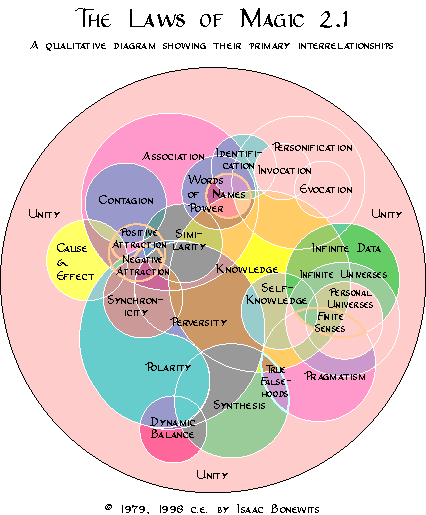 Sturgeon's Law says that 90% of everything is Crud. My addition would be if you're lucky, because it's usually more like 100%.
However, sometimes you can find interesting and useful nuggets of truth in a midden-heap of nonsense. A case in point is Isaac Bonewitz' "Laws of Magic", many of which are astoundingly quite useful for any Scientist or Engineer, no matter how, um, sceptical we may be of the whole neopagan edifice of Sturgeonosity.
Consider the following:
The Law of KnowledgeWhat is this, but the principle underlying scientific research with technological applications?
Essence: Understanding brings control; the more that is known about a subject, the easier it is to exercise control over it.
The Law of Cause & EffectRepeatability of experimental results is an essential requirement for the Scientific Method to work.
Essence: if exactly the same actions are done under exactly the same conditions, they will usually be associated with exactly the same "results;" similar strings of events produce similar outcomes.
The Law of SynchronicityFinding correlations between synchronous events, then determining any causal link : Did A cause B, B cause A, were both A and B caused by some event C, or is it all a coincidence - is a Science in itself, dealt with by the practice of Statistical Analysis.
Essence: Two or more events happening at the same time are likely to have more associations in common than the merely temporal; very few events ever really happen in isolation from nearby events.
The Law of ContagionSee Quantum Entanglement : "...measurements performed on one system seem to be instantaneously influencing other systems entangled with it.
Essence: Objects or beings in physical or psychic contact with each other continue to interact after separation.
...
Quantum entanglement is closely concerned with the emerging technologies of quantum computing and quantum cryptography, and has been used for experiments in quantum teleportation."
The Law of Personal UniversesSee the Many Minds interpretation of Quantum Mechanics.
Essence: Every sentient being lives in and quite possibly creates a unique universe which can never be 100% identical to that lived in by another.
The Law of Infinite UniversesSee the Many Worlds interpretation of Quantum Mechanics.
Essence: The total number of universes into which all possible combinations of existing phenomena could be organized is infinite.
The Law of True FalsehoodsAnyone who has worked with physicis will have used Newtonian physics within its appropriate domain, Special Relativity when that's appropriate, and General Relativity in special cases. All are equally "true", inasmuch as they're all approximations to Reality which are good enough to work with within limited domains.
Essence: It’s possible for a concept or act to violate the truth patterns of a given universe (including an individual’s or group’s part of a consensus reality) and yet to still be "true," provided that it "works" in a specific context.
The Law of PerversityIs there a single Engineer out there who doesn't have a deep and abiding Faith in this one?
Essence: also known as "Murphy’s Law," "Finagle’s Law," etc.: if anything can go wrong, it will — and in the most annoying manner possible.
The Laws are worth a read, anyway, if only as an intellectual construct that shows that some people have very different beliefs than others.
Saturday, 25 February 2006
Quantum Computing Weirdness
File this one under Interesting URL's, plus software too.
From New Scientist :
The Zeno effect? How paradoxical.
It's said "a watched pot never boils". Well, in the world of quantum physics, watch it often enough, and it can't. Every time you look at an unstable particle, you collapse its wavefunction for a bit.
I'm not sure of the large-scale ramifications of this one, but it proves once more that Reality, if you look very closely, is not so much Real as Surreal.
From New Scientist :
Even for the crazy world of quantum mechanics, this one is twisted. A quantum computer program has produced an answer without actually running.
The idea behind the feat, first proposed in 1998, is to put a quantum computer into a “superposition”, a state in which it is both running and not running. It is as if you asked Schrödinger's cat to hit "Run".
With the right set-up, the theory suggested, the computer would sometimes get an answer out of the computer even though the program did not run. And now researchers from the University of Illinois at Urbana-Champaign have improved on the original design and built a non-running quantum computer that really works.
They send a photon into a system of mirrors and other optical devices, which included a set of components that run a simple database search by changing the properties of the photon.
The new design includes a quantum trick called the Zeno effect. Repeated measurements stop the photon from entering the actual program, but allow its quantum nature to flirt with the program's components - so it can become gradually altered even though it never actually passes through.
"It is very bizarre that you know your computer has not run but you also know what the answer is," says team member Onur Hosten.
This scheme could have an advantage over straightforward quantum computing. "A non-running computer produces fewer errors," says Hosten. That sentiment should have technophobes nodding enthusiastically.
Journal reference: Nature (vol 439, p 949)
The Zeno effect? How paradoxical.
It's said "a watched pot never boils". Well, in the world of quantum physics, watch it often enough, and it can't. Every time you look at an unstable particle, you collapse its wavefunction for a bit.
I'm not sure of the large-scale ramifications of this one, but it proves once more that Reality, if you look very closely, is not so much Real as Surreal.
Thursday, 28 April 2005
Spindle Cells, Consciousness, and the Singularity
This one's a Brain post, and a half.
From a fact article in Asimov's SF Magazine, some quotes to ponder :
Think about the Mona Lisa. The hardware is just a few pigments, and a vegetable-based fibrous substrate. It's the arrangement of those that's important, not the raw materials.
But we now have a good handle on the raw materials, and are getting better and better at figuring out what the patterns are. Although at the ultimate level of quantum states of individual subatomic particles, to measure is to change what's being measured, that's not important, because our brains are changing in far more massive ways from moment to moment, yet we still retain the illusion(?) of continuity. Another quote:
Science is full of disappointments: things we thought we'd be able to do "in 20 years time" that 20 yeasr later, we find we can't. Lunar bases. The Cure for Cancer. True AI, of the "HAL 9000" variety.
But compared with 20 years ago, many cancers are curable. And getting a lunar base going is not a matter of technology so much as economic priority. The latest programs for playing chess can now beat the best humans (while remaining dumb-as-a-post). In 1985, some of us were struggling with the problems of transferring data internationally via the ARPAnet/Internet. We really believed cerebrally that by 2005, most computers in the planet would be hooked up together, but not vicerally, it seemed too good to be true.
It's just possible that if you, the reader, can hang on for another 30 years without snuffing it, you may be able to get an upgrade to better hardware. Will it be "the same" as you? Not exactly. But it will be closer to the "you" of 2035 than that "you" is to the "you" of today. In fact, it will be closer than the "you" you were when you started treading this article, and the "you" you are now that you've finished reading it.
Close enough.
UPDATE : George Jr has some cogent thoughts on the subject, and writes :
From a fact article in Asimov's SF Magazine, some quotes to ponder :
Here in the twenty-first century we like to view ourselves as ambulatory brains, plugged into meat-puppets that lug our precious grey matter from place to place. We tend to think of that grey matter as transcendently complex, and we think of it as being the bit that makes us us.Perhaps the definition of "intelligent life" might have to include all animals with spindle cells, and thus the capacity for love, hate, and so on.
But brains aren’t that complex, Kurzweil says. Already, we’re starting to unravel their mysteries.
"We seem to have found one area of the brain closely associated with higher-level emotions, the spindle cells, deeply embedded in the brain. There are tens of thousands of them, spanning the whole brain (maybe eighty thousand in total), which is an incredibly small number. Babies don’t have any, most animals don’t have any, and they likely only evolved over the last million years or so. Some of the high-level emotions that are deeply human come from these.
Scanning resolution of human tissue–both spatial and temporal–is doubling every year, and so is our knowledge of the workings of the brain. The brain is not one big neural net, the brain is several hundred different regions, and we can understand each region, we can model the regions with mathematics, most of which have some nexus with chaos and self-organizing systems. This has already been done for a couple dozen regions out of the several hundred.Recent - as in, within the last 20 years - advances in mathematics in the fields of Chaos Theory and Self-organising systems have been crucial in solving many problems, from the behaviour of flocks of birds and schools of fish, to turbulent flow out of a common household tap. We have tools now that enable us to undrestand much of what we could merely observe in the dim, dark and distant past of 1970.
"We have a good model of a dozen or so regions of the auditory and visual cortex, how we strip images down to very low-resolution movies based on pattern recognition. Interestingly, we don’t actually see things, we essentially hallucinate them in detail from what we see from these low resolution cues. Past the early phases of the visual cortex, detail doesn’t reach the brain.Meanwhile, with Psychology and Psychiatry, most medical schools are still in the "Ju Ju and Witchdoctor" stage, doing the equivalent of bleeding the patients to remove evil humours. Most, but not all. And we now have an arsenal of psychotropic drugs whose effects may be extremely crude, but still effective. The equivalent of amputations to cure gangrene, rather than antispesis and antibiotics. Still more effective than making passes with relics of saints.
"We are getting exponentially more knowledge. We can get detailed scans of neurons working in vivo, and are beginning to understand the chaotic algorithms underlying human intelligence. In some cases, we are getting comparable performance of brain regions in simulation. These tools will continue to grow in detail and sophistication.I''ll repeat one bit, one very important bit :
"We can have confidence of reverse-engineering the brain in twenty years or so. The reason that brain reverse engineering has not contributed much to artificial intelligence is that up until recently we didn’t have the right tools. If I gave you a computer and a few magnetic sensors and asked you to reverse-engineer it, you might figure out that there’s a magnetic device spinning when a file is saved, but you’d never get at the instruction set. Once you reverse-engineer the computer fully, however, you can express its principles of operation in just a few dozen pages.
"Now there are new tools that let us see the interneuronal connections and their signaling, in vivo, and in real-time. We’re just now getting these tools and there’s very rapid application of the tools to obtain the data.
"Twenty years from now we will have realistic simulations and models of all the regions of the brain and [we will] understand how they work. We won’t blindly or mindlessly copy those methods, we will understand them and use them to improve our AI toolkit. So we’ll learn how the brain works and then apply the sophisticated tools that we will obtain, as we discover how the brain works.
We can have confidence of reverse-engineering the brain in twenty years or so.But wait, there's more :
But Kurzweil doesn’t think that the future will arrive in a rush. As William Gibson observed, "The future is here, it’s just not evenly distributed."The human brain's "wetware", the physical bits, turns out to be a lot less complex than we'd ever imagined, just as the arrangements and patterns within it are even more complex.
"Sure, it’d be interesting to take a human brain, scan it, reinstantiate the brain, and run it on another substrate. That will ultimately happen."
"But the most salient scenario is that we’ll gradually merge with our technology. We’ll use nanobots to kill pathogens, then to kill cancer cells, and then they’ll go into our brain and do benign things there like augment our memory, and very gradually they’ll get more and more sophisticated. There’s no single great leap, but there is ultimately a great leap comprised of many small steps.
Think about the Mona Lisa. The hardware is just a few pigments, and a vegetable-based fibrous substrate. It's the arrangement of those that's important, not the raw materials.
But we now have a good handle on the raw materials, and are getting better and better at figuring out what the patterns are. Although at the ultimate level of quantum states of individual subatomic particles, to measure is to change what's being measured, that's not important, because our brains are changing in far more massive ways from moment to moment, yet we still retain the illusion(?) of continuity. Another quote:
(Ray Kurzweil speaks) If you follow that logic, then if you were to take me ten years ago, I could not pass for myself in a Ray Kurzweil Turing Test. But once the requisite uploading technology becomes available a few decades hence, you could make a perfect-enough copy of me, and it would pass the Ray Kurzweil Turing Test. The copy doesn’t have to match the quantum state of my every neuron, either: if you meet me the next day, I’d pass the Ray Kurzweil Turing Test. Nevertheless, none of the quantum states in my brain would be the same. There are quite a few changes that each of us undergo from day to day, we don’t examine the assumption that we are the same person closely.Take a look around you. The world in only 20 years time will be quite different, yet remain much the same in many ways. We already have the first prosthetic brain part replacements. In 20 years time, we may have some really good idea of how to go about implementing a human mind on non-biological hardware. Either "copying" an existing one, or making one out of whole cloth.
"We gradually change our pattern of atoms and neurons but we very rapidly change the particles the pattern is made up of. We used to think that in the brain–the physical part of us most closely associated with our identity–cells change very slowly, but it turns out that the components of the neurons, the tubules and so forth, turn over in only days. I’m a completely different set of particles from what I was a week ago.
"Consciousness is a difficult subject, and I’m always surprised by how many people talk about consciousness routinely as if it could be easily and readily tested scientifically. But we can’t postulate a consciousness detector that does not have some assumptions about consciousness built into it.
"Science is about objective third party observations and logical deductions from them. Consciousness is about first-person, subjective experience, and there’s a fundamental gap there. We live in a world of assumptions about consciousness. We share the assumption that other human beings are conscious, for example. But that breaks down when we go outside of humans, when we consider, for example, animals. Some say only humans are conscious and animals are instinctive and machinelike. Others see humanlike behavior in an animal and consider the animal conscious, but even these observers don’t generally attribute consciousness to animals that aren’t humanlike.
"When machines are complex enough to have responses recognizable as emotions, those machines will be more humanlike than animals."
Science is full of disappointments: things we thought we'd be able to do "in 20 years time" that 20 yeasr later, we find we can't. Lunar bases. The Cure for Cancer. True AI, of the "HAL 9000" variety.
But compared with 20 years ago, many cancers are curable. And getting a lunar base going is not a matter of technology so much as economic priority. The latest programs for playing chess can now beat the best humans (while remaining dumb-as-a-post). In 1985, some of us were struggling with the problems of transferring data internationally via the ARPAnet/Internet. We really believed cerebrally that by 2005, most computers in the planet would be hooked up together, but not vicerally, it seemed too good to be true.
It's just possible that if you, the reader, can hang on for another 30 years without snuffing it, you may be able to get an upgrade to better hardware. Will it be "the same" as you? Not exactly. But it will be closer to the "you" of 2035 than that "you" is to the "you" of today. In fact, it will be closer than the "you" you were when you started treading this article, and the "you" you are now that you've finished reading it.
Close enough.
UPDATE : George Jr has some cogent thoughts on the subject, and writes :
It chimed with some of my recent reading - I've just finsihed Pinker's How the Mind Works and, yesterday, I received a copy of Julian Jaynes's work The Origin of Consciousness in the Breakdown of the Bicameral MInd.
Tuesday, 16 November 2004
Creation "Science"
A School Curriculum report I'd like to see :
Miskatonic University's Board of Governors has decided that "Creation Science" should now be taught alongside the more usual Evolution-Theory-based Biology and Quantum Superstring-Theory-based Cosmology courses.After all, this is about "Science" and not any particular religion, isn't it?
In keeping with our American heritage, the primary theory being taught will be that of the Lakota Nation of Native Americans, and the majority of the course will concentrate on the roles of Thunderbird and Coyote, and experimental verification of the Theory. Students engaged in Advanced studies will perform a critical analysis and comparison of the primary Theory with that of the Arunta people of Northern Australia, in particular the concept of the "Dreamtime" and the role of the Rainbow Serpent. Experiments will be designed and performed to distinguish which Theory is more accurate.
Classes will also be taught in less detail about other competing theories, such as the Lesser- and Greater- Path Buddhist, Zoroastrian, Hindu, Classical Greek, Islamic, Judeo-Christian, Taoist and Shinto theories, approximately half-an-hour on each.
Thursday, 17 June 2004
Breakthrough in Teleportation
This story is a Big Deal. So is this one.
Simply, we're now able to copy an atom, duplicating everything about it except its position and velocity in a new atom somewhere else. The original atom's characteristics get changed in the process, it is no longer the atom that it was.
Some Mini-FAQs:

The next few centuries should be interesting. It is looking increasingly likely that before a thousand more years has passed, neither humanity nor civilisation as we know it will exist in any recogniseable form. I'm not talking about the relatively minor differences between, say, Middle Kingdom Egypt of 4000 years ago and today, or even the difference between Homo Erectus and today. Something far more strange and wonderful.
Time to start saving if I don't want to miss it.
Simply, we're now able to copy an atom, duplicating everything about it except its position and velocity in a new atom somewhere else. The original atom's characteristics get changed in the process, it is no longer the atom that it was.
Some Mini-FAQs:
- Is it FTL?
This article says not, but I can think of ways around it. Working from dumbed-down-for-journalists stories rather than the Maths, I can't say. There's reason to think it may be. - Is it affected by Distance?
Again, without looking at the Maths, I don't know, but there's strong evidence to think that it isn't. - Is it a Star Trek-like transporter?
No. But this article shows that such a thing is not impossible due to quantum uncertainty. Of course the engineering involved is non-trivial, it may take a significant time (which is Engineer-speak for saying 'Only when Hell Freezes Over') and could mean Billions of years. - So what is it good for?
In the immediate future -- Making quantum computers a LOT faster. Timescale : a decade or two. This is the big area of interest in the publicity at the moment.
- Absolutely Secure Communication. This hasn't been mentioned, but my bet is that Quantum Entanglement will be used in the very near future (<10 years) for military-grade communications that would be difficult to jam, impossible to intercept without anyone knowing, and guarded by the Laws of Physics rather than the ability to compute really large numbers. (Good job, as Quantum computers will be really good at doing this)
- The effect is absolutely independant of intervening stuff, such as planets, stars, parsecs-of-lead etc. Without examining the Maths, I'm not sure if it would be affected by one part being inside a Black Hole's event horizon, but an intervening Black Hole would have no effect.
The next few centuries should be interesting. It is looking increasingly likely that before a thousand more years has passed, neither humanity nor civilisation as we know it will exist in any recogniseable form. I'm not talking about the relatively minor differences between, say, Middle Kingdom Egypt of 4000 years ago and today, or even the difference between Homo Erectus and today. Something far more strange and wonderful.
Time to start saving if I don't want to miss it.
Subscribe to:
Posts (Atom)